Light, settings, kit and respect: what really matters on a photographic safari.
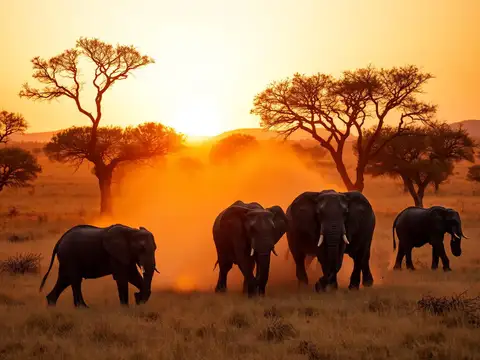
Good light on the savannah does not last long. Close to the equator, in Kenya and northern Tanzania, you have roughly forty usable minutes after sunrise and before sunset. Everything you have read about composition matters less than being in the right place when that light arrives, and that is a planning question more than a photographic one: leave early, know where you are going, do not spend the first hour at breakfast.
Position and approach
Shoot low when you can. A safari vehicle window sits about two metres above the ground and flattens everything: pick the lowest seat or, where there is one, a ground-level hide. Ask your guide to approach at an angle rather than head-on, switch off the engine and wait. Animals relax within a few minutes of a stationary vehicle, and a relaxed animal behaves naturally, which is exactly what you want to photograph. A switched-off engine helps you too, because it removes vibration.
Exposure and settings
Expose for the highlights. At sunrise the sky is much brighter than the animal in front of you, so underexpose by about two-thirds of a stop and lift the shadows later. Backlit dust will add atmosphere to the shot. Shoot RAW, so you have room to work.
A few starting points for shutter speed:
- a still animal, with a long lens: at least 1/500 of a second;
- an animal walking or moving: 1/1000;
- an animal running, or birds in flight: 1/2000 and faster;
- deliberate motion blur, following the animal (panning): between 1/30 and 1/125.
Let the camera set ISO automatically, with a maximum you are comfortable with. Use continuous autofocus, aim for the animal's eye and shoot in bursts: out of ten frames, one usually has the right look. When you shoot, ask the others on board to keep still for a few seconds.
Lenses and support
Bring one long lens and one wide. A 100-400 zoom covers almost every game drive. The wide angle earns its place at camp, on the airstrip and on days when the landscape is the subject. A beanbag, a small bag filled with rice or beans resting on the window frame, is more useful than a tripod, which has nowhere to go in a vehicle. If you are flying in small aircraft, remember that camera gear counts towards the weight allowance, often 15 kg per person in Kenya and Tanzania, hand luggage included.
Dust, batteries and memory cards
Dust is the main enemy. Change lenses as little as possible, never in the wind and never on dirt tracks: do it at camp or inside a half-open bag. Between sightings, cover the camera with a cloth bag or a scarf. Bring an air blower and a microfibre cloth. No plastic bags: they are banned in Kenya and Tanzania.
In many camps electricity comes from solar panels or generators, sometimes only at certain hours, and charging often happens in the main area rather than in your tent. Some vehicles have USB sockets, but do not count on it. Bring at least two spare batteries and a charger with several ports. On safari you shoot far more than you expect: bring plenty of cards and, every evening, copy your photos to a second device.
Respect for wildlife and for people
The rule is simple: if the animal changes its behaviour because of you, you are too close. It stops eating, stares at you, flicks its ears, moves away: that is the moment to back off. No calls or noises to make it turn towards you, no flash at night, no asking the guide to leave the track where it is not allowed. Leave the drone at home: it is banned in Tanzania's national parks, and in Kenya it needs civil aviation authorisation, which in practice tourists do not get for the parks.
Always ask before photographing people. In Maasai and Samburu communities a portrait is a relationship, not a transaction, and your guide will know how to introduce you. If a contribution is customary, agree on it beforehand and give it directly to the person. With children, ask their parents.
Best time
From June to October, in the dry season, wildlife gathers near water. In January and February the green season brings lush landscapes, dramatic skies and, in the southern Serengeti, the wildebeest calving. April and May bring heavy rain and several camps close. If the river crossings of the migration are your goal, aim for late July to October, accepting that nature keeps its own calendar.
One last thing: at least once on every drive, put the camera down. The photo you do not take is often the one you remember best.
Want a trip built like this? Tell us about it on a free call.
The Dream Destination editorial team